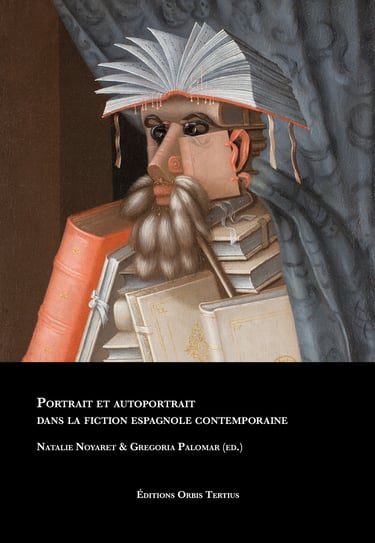
Titre : Portrait et autoportrait dans la fiction espagnole contemporaine
Soustitre : —
Année de publication : 2023
Type d'ouvrage : Ouvrage collectif
Collection : NEC+
Disciplines / Champ scientifique : x
Texte de présentation
Le portrait et l’autoportrait sont des éléments constitutifs de la fiction et de la mise en place des personnages. Ils peuvent donner à voir ou laisser une part d’ombre, et, tout en s’offrant comme une copie de la réalité, ils sont aussi un instrument de manipulation de celle-ci. Aussi les chercheurs de la NEC+ se sont-ils interrogés sur la place qu’occupe le portrait ou l’autoportrait dans le vaste champ de la fiction narrative qui s’est développé en Espagne depuis l’aube du XIXe siècle jusqu’à nos jours.
En se basant sur un large éventail d’écrivains (Javier Moro, Emilia Pardo Bazán, Vicente Luis Mora, Javier Cercas, Mario Cuenca Sandoval, Alfons Cervera, Belén Gopegui, Sara Mesa, Antonio Altarriba et Keko, Gustavo Martín Garzo, Fernando Aramburu, Javier Marías, Soledad Puértolas), les auteurs des quinze études de ce volume ont tenté de répondre aux multiples questions que suscite l’art de portraire l’autre ou de se portraire : sert-il de base à un récit centré sur un personnage ? Permet-il de dresser un portrait de la société dans laquelle s’inscrivent les personnages ? S’agissant de l’autoportrait, la relation avec sa propre image est-elle transcendée par l’écriture ? Portrait et autoportrait ne sont-ils pas intimement liés ?
Toutes ces études prennent appui sur la conférence de Philippe Merlo-Morat qui souligne les liens existant entre le portrait pictural et le portrait littéraire, ainsi que sur le riche dialogue entre Alfons Cervera et Marie Gourgues.
Mot-clés :
Hebraica veritas, Castille, conversos, Juifs, XVe siècle
Auteur : Natalie Noyaret
Numéro ORCID : x
Affiliation institutionnelle : x
Title
Portrait and Self-Portrait in Contemporary Spanish Fiction
Abstract
Portraits and self-portraits are fundamental elements of fiction and character development. They can reveal or conceal aspects of a subject, and while presenting themselves as copies of reality, they are also instruments for manipulating it. NEC+ researchers have therefore examined the place of portraiture and self-portraiture in the vast field of narrative fiction that has developed in Spain from the dawn of the 19th century to the present day. Drawing on a wide range of writers (Javier Moro, Emilia Pardo Bazán, Vicente Luis Mora, Javier Cercas, Mario Cuenca Sandoval, Alfons Cervera, Belén Gopegui, Sara Mesa, Antonio Altarriba and Keko, Gustavo Martín Garzo, Fernando Aramburu, Javier Marías, Soledad Puértolas), the authors of the fifteen studies in this volume have attempted to answer the many questions raised by the art of portraying others or portraying oneself: does it serve as the basis for a character-centred narrative? Does it allow us to paint a portrait of the society in which the characters live? When it comes to self-portraiture, is the relationship with one's own image transcended by writing? Are portraiture and self-portraiture not intimately linked? All these studies are based on Philippe Merlo-Morat's lecture, which highlights the links between pictorial portraiture and literary portraiture, as well as on the rich dialogue between Alfons Cervera and Marie Gourgues.
Keywords
Portrait ; Self-Portrait ; Portrait of Society ; Image ; Reality ; Spanish fiction
Bibliographic and Publishing Data
DOI :
Open access URL:
ISBN (PDF) :
ISBN (Print) : 978-2-36783-209-8
EAN : 9782367832098
ISSN (Collection) :
Pagination : 388
Format : Paperback, 145 x 210 mm
Weight : 0.615 kg
Price : €39.95
Évaluation scientifique
Scientific evaluation by the project’s academic institution
Open Access
Licence
CC-BY-NC-ND 4.0
Indexation
Biblioteca Virtual Cervantes
Crossref
Ouvrage publié avec le soutien de
Auteur : Gregoria Palomar
Numéro ORCID : 0000-0003-0782-7695
Affiliation institutionnelle : x
Contact
info@editionsorbistertius.com
+33 (0) 782686850
© 2026. All rights reserved.